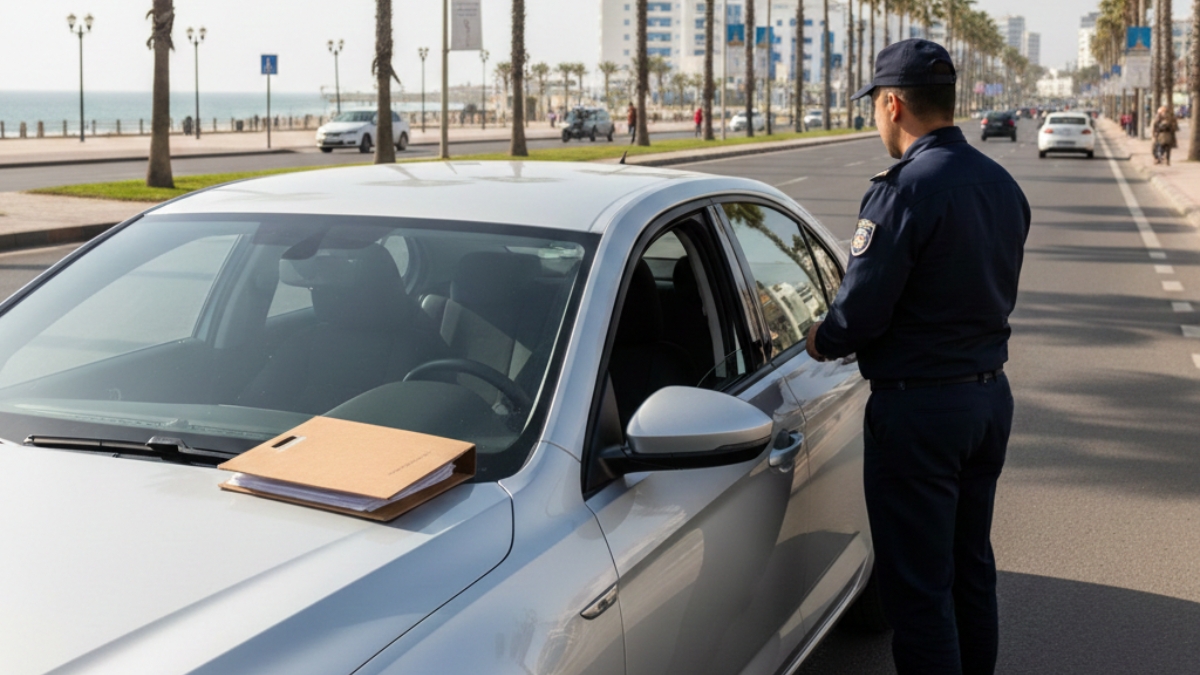
Driving in Agadir is one of the best ways to explore the bay, Taghazout/Tamraght, and the roads heading toward Essaouira or Marrakech. But as a tourist, you’ll quickly notice two things: police checks are common, and officers expect your papers to be in order. If you know what to keep in the car and how to behave at a checkpoint, these stops are usually quick and routine.
This guide walks you through police checks, mandatory documents, insurance papers, and the basic safety items you should always carry in your rental car while staying in Agadir.
Table of Contents (Checklist)
- 1) How police checks work in Agadir (normal vs “problem” stops)
- 2) Mandatory documents you must have with you
- 3) Insurance papers: what they are and why they matter
- 4) Extra items to keep in the car (safety & comfort)
- 5) What to do if you’re stopped: step-by-step
- 6) Common mistakes tourists make (and how to avoid them)
- 7) Quick “ready-to-drive” checklist for Agadir
- FAQ
1) How police checks work in Agadir
You’ll see checkpoints:
- at the entrance and exit of Agadir
- on the coastal road toward Taghazout / Tamraght
- on main city avenues and roundabouts
- on intercity roads toward Marrakech or Tiznit
Most checks are routine and last 1–2 minutes if your documents are correct.
What officers are usually looking for:
- valid driving licence
- vehicle registration (carte grise)
- valid insurance
- seat belt use and basic road behaviour
- sometimes your passport/ID if deeper checks are needed
The UK’s foreign travel advice for Morocco specifically recommends that drivers always carry their insurance, licence and registration documents when driving in the country. GOV.UK – Morocco travel advice: Safety and security (driving)
If everything is in order, you’re usually waved on with a polite “shukran / merci / thank you.”
2) Mandatory documents you must have with you
Even in a rental car, Moroccan rules still apply. NARSA (the national road safety agency) lists the essential documents you must have to legally drive a vehicle in Morocco: valid driving licence, insurance certificate, and vehicle registration document. Conduire au Maroc : la check-list des équipements et papiers
As a tourist in Agadir, that translates to:
A) Your driving licence
- Original licence, not just a photo
- If your licence isn’t in Latin characters, an International Driving Permit (IDP) is strongly recommended
- Only drive the category of vehicle your licence allows
B) Passport (or national ID where applicable)
- Keep the original with you or safely accessible
- Many officers will accept a photo, but you should be ready to show the real document if requested
C) Vehicle papers (provided by the rental company)
These usually include:
- Registration document (carte grise)
- Insurance certificate
- Sometimes a separate technical inspection / tax vignette visible on the windscreen
D) Rental contract
Always keep a copy (paper or digital) in the car. It shows:
- who is supposed to be driving
- dates of the rental
- company contact details in case officers wish to verify
3) Insurance papers: what they are and why they matter
In Agadir, as anywhere in Morocco, you’re expected to have valid insurance for the vehicle you’re driving. With a rental car, the basic insurance is usually built into your contract, but you still need the physical proof in the glovebox.
What you’ll typically see in the car
- Insurance certificate: confirms the car is insured in Morocco
- Sometimes an insurance green card if the car is coming from abroad
Police can ask to see this at any checkpoint. It proves the car is legal on the road and that liability cover exists.
Optional extra cover (CDW, SCDW, etc.)
Your rental company may offer additional coverage:
- to reduce your excess/deductible
- to cover glass/tires/undercarriage, which are often excluded
- to provide extra peace of mind on long trips (Agadir → Marrakech, etc.)
These options may be printed in your rental agreement or attached as an extra document. Keep it where you can show it quickly if there’s an incident.
4) Extra items to keep in the car (safety & comfort)
Beyond papers, it’s smart to keep some basic equipment in the vehicle. NARSA’s checklist mentions required items like valid documents; many local guides also recommend certain safety accessories for longer trips.
Helpful items:
- Warning triangle (for breakdowns or minor incidents)
- Hi-vis vest (good practice if you step onto the road at night)
- Phone mount + charging cable (for navigation without holding the phone)
- Bottle of water, especially in summer or on highway routes
- Printed address of your hotel/riad in French or Arabic, in case GPS/phone fails
Some rental companies provide a triangle and basic kit as standard. If you’re not sure, ask at pickup.
5) What to do if you’re stopped: step-by-step
Police checks in Agadir are usually polite and structured. Here’s how to make them even quicker:
- Slow down early and stop where indicated.
- Open your window, remove sunglasses, and say hello (Bonjour / Salam / Hi).
- Have your licence and vehicle papers ready, preferably in one folder.
- Answer questions clearly and calmly (where you’re coming from, where you’re going).
- Only get out of the car if they ask you to.
- When the officer hands your papers back and signals to go, thank them and rejoin traffic safely.
If you don’t understand French or Arabic, you can politely say you speak English and keep your answers short and clear.
6) Common mistakes tourists make (and how to avoid them)
❌ Keeping documents buried in luggage
You don’t want to unpack half the trunk at a roadside check. Keep papers in the glovebox or a small folder by the driver.
❌ Relying only on digital copies
Screenshots help, but officers may insist on original documents for licence, passport, and car papers.
❌ Forgetting seat belts in low-speed areas
Seat belt rules apply inside Agadir just like on the highway. Always buckle up, front and rear.
❌ Driving with expired or unclear licence
Make sure your licence is valid for the whole trip and that the characters are readable. If not, bring an IDP.
❌ Panicking at checkpoints
Checks are common and often friendly. If you’re calm, prepared, and respectful, they’re just a 1–2 minute pause in your journey.
7) Quick “ready-to-drive” checklist for Agadir
Before you leave the rental office or hotel car park, confirm you have:
In your wallet / on you:
- Passport or national ID
- Driving licence (and IDP if recommended for your country)
In the car:
- Vehicle registration (carte grise)
- Insurance certificate
- Rental contract (paper or digital)
- Breakdown/assistance number from the rental company
- Warning triangle (and ideally a hi-vis vest)
- Phone mount and charger
- Written address of your stay in Agadir
Screenshot this list and keep it on your phone, you’ll only need to set it up once.
FAQ
Are police checks in Agadir normal?
Yes. They’re common across Morocco and usually routine as long as your documents and driving behaviour are in order.
Do I need to carry my passport while driving?
You should be prepared to show your passport or ID if requested, even if officers sometimes accept a photo. Originals are safer in case of deeper checks.
Can I drive with my home-country licence?
Many tourists do, but an International Driving Permit is often recommended, especially if your licence isn’t in Latin characters or clearly understood by local officers.
What happens if I don’t have the car’s registration or insurance document?
You can be fined and, in some cases, the vehicle can be immobilised. Always make sure the rental company gives you complete papers at pickup.
Do I need extra insurance beyond the basic one in my rental?
Not legally, but it can be very helpful financially. Extra cover can reduce your excess and protect against more types of damage.
How long does a typical checkpoint take in Agadir?
If your documents are ready and you’re polite, usually 1–3 minutes.