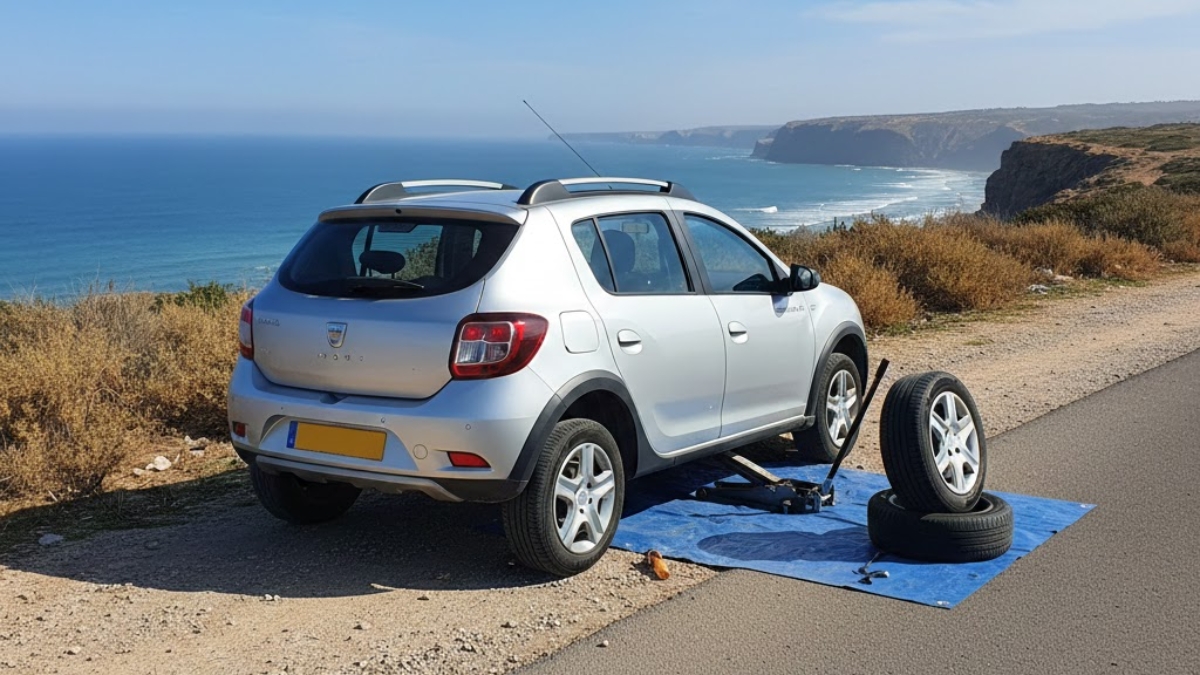
A flat tire in Agadir is usually a manageable interruption, not a trip-stopper, if you know what your rental includes and you follow a safe escalation path. The key is to separate two questions: (1) Can the car be made safely drivable right now? and (2) Who is responsible for the tire cost and the service logistics? This guide gives you a practical, rental-friendly process that works for city driving, coastal routes (Taghazout), and day trips inland.
Table of Contents
- Quick Answer
- First Priority: Safety and Road Positioning
- What’s Typically Included in a Rental in Agadir
- Step-by-Step: What to Do When the Tire Goes Flat
- When You Should Not Change the Tire Yourself
- Who to Call in Agadir
- What Costs Are Usually Covered
- After the Spare Is On: How to Continue Safely
- Practical Checklists
- FAQ
- Conclusion
Quick Answer
If you get a flat tire in Agadir: pull over somewhere safe, switch on hazards, keep passengers away from traffic, and locate your spare/tools (or repair kit). Then call your rental agency/agent first and follow their instructions. If you are on the motorway, use the official motorway assistance number. Take clear photos of the tire and wheel before any repair, and do not authorize major work until the agency confirms what is covered.
First Priority: Safety and Road Positioning
Before you touch tools or call anyone, make the scene safe:
- Move off the driving lane (shoulder, parking bay, service area). If you are in a tight city street, aim for the nearest safe pull-in even if the tire is low, slowly.
- Hazard lights on immediately.
- Passengers out of the roadway: on highways, behind the barrier if available.
- Parking brake engaged, wheels turned slightly away from traffic if stopped on a slope.
If you feel unsafe (night, high-speed road edge, no shoulder), treat it as an assistance situation, not a DIY situation.
What’s Typically Included in a Rental in Agadir
Do not assume every rental has a full-size spare. In Morocco, you can encounter three setups:
1) Full spare + tools
Usually includes:
- Spare wheel (full-size or temporary)
- Jack
- Lug wrench
- Tow hook (sometimes)
- Wheel-lock key (if the car has locking nuts)
2) Temporary spare (“donut”)
Common on smaller cars. It gets you moving, but it’s not intended for long, fast driving.
3) Tire repair kit (no spare)
Some newer cars carry a compressor + sealant instead of a spare. This can work for small punctures but is not appropriate for sidewall damage or a blowout.
Pickup best practice (30 seconds): open the trunk, find the tire kit/spare, confirm the jack and wrench are present, and ask the agent what to do if you puncture.
Step-by-Step: What to Do When the Tire Goes Flat
Step 1: Document the situation (before changes)
Take photos of:
- The flat tire (close-up)
- The wheel/rim (close-up)
- The car’s position relative to the road (wide shot)
- Any visible cause (nail/screw/pothole edge if clear)
This protects you if there is a later dispute about rim damage or “where it happened.”
Step 2: Identify the type of damage
- Slow leak/puncture: often repairable.
- Sidewall cut/bulge: usually not repairable; you’ll likely need a replacement.
- Blowout: treat as high-risk; do not attempt a sealant kit.
Step 3: Decide: spare change, repair kit, or assistance
- If you have a spare and a safe location, a wheel change can be the fastest solution.
- If you only have a repair kit, confirm with the agent whether to use it (sealant can complicate later tire repair).
- If it’s unsafe or the damage is severe, call for assistance.
Step 4: If you are changing the wheel, use a safe method
A clear step-by-step reference for safe tire changing (including key safety warnings) is Michelin’s guide: https://middle-east.michelin.com/en/auto/auto-tips-and-advice/tire-maintenance/how-to-change-a-car-tire.
Use the correct jacking points (often shown on the car’s sill label/manual), loosen lug nuts before lifting, and tighten evenly after lowering.
When You Should Not Change the Tire Yourself
Do not DIY if any of these are true:
- You are stopped on a narrow shoulder or high-speed edge with poor visibility.
- You do not have the correct tools (especially the wheel-lock key).
- The ground is soft/uneven and the jack will be unstable.
- You’re unsure about jacking points (risk of underbody damage).
- The damage is a blowout or severe rim impact.
In these cases, assistance is the correct call.
Who to Call in Agadir
1) Your rental agency/agent (first call)
They decide the approved process: where to go, which tire shop they use, whether they dispatch roadside support, and how payment/reimbursement is handled.
2) If you are on the motorway (autoroute)
Call the official Autoroutes du Maroc call center 5050, which is the published motorway assistance line for users on the autoroute network. https://www.adm.co.ma/fr/notre-centre-dappel-5050
3) Emergency services (only if safety/medical risk)
If there is an accident risk, injury, or you feel unsafe:
- UK travel guidance lists Morocco emergency services as Police 190, Gendarmerie 177, and Ambulance/Fire 150.
- Some official/embassy guidance also notes 112 can be used from a mobile for police assistance and that 19 may be used for police from fixed lines.
Practical interpretation: if you are unsure which service applies, using the commonly advised emergency options above is the fastest path to help.
What Costs Are Usually Covered
This varies by agency and package, but the pattern is consistent in car rentals globally:
- Roadside help to fit a spare is sometimes included (or arranged) if the car has a spare and you are in a reasonable location.
- The tire itself (repair or replacement) is often treated as the renter’s responsibility unless you have a specific tire/wheel coverage add-on or a premium protection plan that explicitly includes tires and rims.
- Rim damage from impact can be treated differently than a simple puncture, take photos early.
The only safe rule is: do not assume “full insurance” includes tires unless your contract states it.
After the Spare Is On: How to Continue Safely
- Drive conservatively and avoid high speed until the tire is inspected.
- If it’s a temporary spare, follow the car’s sticker/manual guidance on speed and distance limits (it varies by vehicle).
- Go directly to the agency-approved tire shop if they instruct one.
- Keep receipts and take a photo of any repaired/replaced tire invoice if you pay.
Practical Checklists
At pickup in Agadir (prevent the problem)
- Confirm spare vs repair kit
- Confirm jack + lug wrench + wheel-lock key
- Save the agent’s phone/WhatsApp
- Ask: “If I puncture, which tire shop do you use and who pays first?”
When the flat happens
- Hazards on, pull over safely, passengers protected
- Photos (tire, rim, position)
- Call agent first; autoroute = call 5050
- Do not authorize major repairs until coverage is clear
FAQ
Q: Is a spare tire always included in rentals in Agadir?
A: Not always. Some cars have a spare, others have a temporary spare, and some only have a repair kit. Check at pickup.
Q: Should I use the tire sealant kit immediately?
A: Not until you confirm with the rental agent. Sealant can be the right move for small punctures, but it’s not appropriate for sidewall damage and can complicate later repairs.
Q: Who pays for a puncture repair?
A: Often the renter pays unless the contract includes tire coverage. Always confirm with the agent and keep receipts.
Q: What if the flat happens on the autoroute?
A: Get safe first, then call the official motorway assistance line 5050 and your rental agent.
Q: What emergency number should I use if I feel unsafe or there’s an accident?
A: UK guidance lists Police 190, Gendarmerie 177, and Ambulance/Fire 150 in Morocco.
Q: Can I keep driving slowly on a flat to reach a station?
A: Only if it’s a very short distance to reach a safer pull-off, and only at very low speed. Driving on a fully flat tire can destroy the rim and increase costs.
Conclusion
Handling a flat tire in Agadir is about disciplined steps: make the scene safe, document the tire and rim, confirm what tools you have, and call the right party in the right order (agent first, motorway assistance if on autoroute, emergency services only if safety requires it). If you treat it as a process, you will minimize both downtime and disputes.