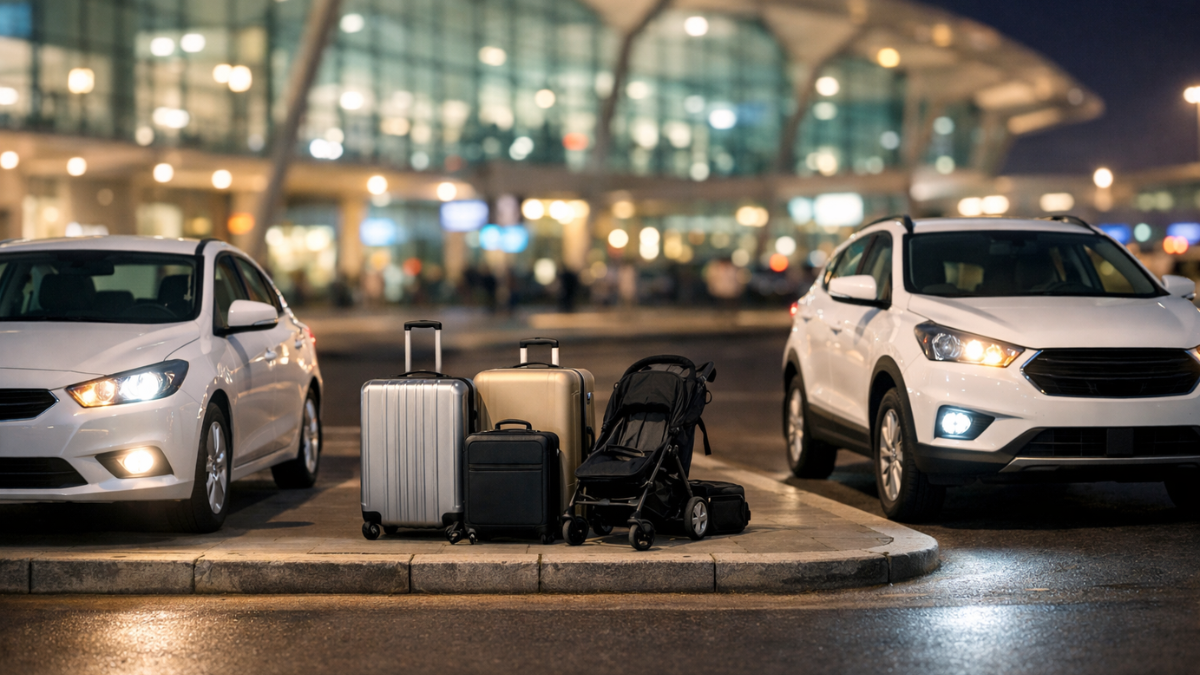
When a group lands together, the first question is usually simple: “Can we all fit in one vehicle?” But the better question is often: “Do we all want to arrive together… or arrive faster?”
Multi-car pickup is the smoothest option for groups with mixed needs, different hotel locations, different luggage volumes, families with strollers, or people who just want zero waiting. And yes: it can involve one coordinator (driver/agent) managing two cars so your arrivals don’t turn into a parking-lot puzzle.
Below is exactly how it works in real life, what you should prepare, and how to avoid the common delays.
Table of contents
- What “multi-car pickup” really means
- When two cars are better than one
- The step-by-step pickup flow (arrival to car doors)
- Meeting points that don’t cause stress
- Documents, deposits, and who signs what
- Luggage strategy for groups
- Timing rules: the 20-minute problem
- Best communication setup for groups
- Common mistakes and how to avoid them
- FAQ
1. What “multi-car pickup” really means
Multi-car pickup is a coordinated handoff where your group is served by two vehicles, managed as one plan. You might have:
- Car A for drivers who will take the wheel immediately
- Car B for extra passengers, extra luggage, or a second driver in your group
- Or two rental cars delivered together, so your group can split to different destinations without delays
Sometimes one person (a coordinator/driver/agent) meets your group, confirms IDs, directs luggage, and walks you to both vehicles, so you’re not doing “Where are you?” phone calls in the arrivals crowd.
2. When two cars are better than one
Two cars usually win when:
- You’re 4–6 people with luggage (especially hard-shell suitcases)
- You have surf gear, strollers, or big baggage
- You’re splitting destinations (some to the city, some to the coast, some to another town)
- You have mixed comfort needs (one small economy car + one larger car)
- You want the fastest exit (one car can be ready while the other finishes a quick check)
Even if everyone could squeeze into a single big vehicle, it often creates a different problem: longer loading time, more time searching for parking, and more stress if one person is delayed at baggage claim.
3. The step-by-step pickup flow (arrival to car doors)
Step 1: “Landing confirmation” message
Before you land, the coordinator sets one simple rule: the group sends a short confirmation when the plane is on the ground (not when you exit the airport). That lets both vehicles time their arrival without waiting too long in short-stay areas.
Step 2: One meeting point, not two
The group meets at one exact point in arrivals. The coordinator checks:
- Who is driving which car
- Who is riding in which car
- Who has the key documents ready (license/passport)
Step 3: Quick ID verification (the “don’t lose time” moment)
To keep it fast, the coordinator does a rapid check:
- Driver 1 → documents ready
- Driver 2 → documents ready
- Everyone else → luggage + seating assignment
This avoids the classic delay where five people are standing around while one driver searches for a passport screenshot.
Step 4: Walk to vehicles in the right order
The coordinator typically takes you to the vehicle that’s ready first:
- If Car A is already positioned, passengers + most luggage go first
- Car B follows once the second handoff is ready
Step 5: Photo + condition check (fast, not endless)
For rentals, a quick walk-around and photos take under two minutes when done correctly:
- Front bumper, rear bumper, wheels, windshield, dashboard fuel level
- One short video if your phone has enough storage
Then you split and go, no crowding, no confusion.
4. Meeting points that don’t cause stress
Airports can be noisy and crowded. The best meeting point is one that’s easy to describe and easy to stand beside without blocking anyone.
A practical move is to agree on one landmark (like a specific door number, a pillar letter, or a clear arrivals-zone marker). If you’re landing in Casablanca (CMN) or any other airport, you can confirm the airport’s official access layout and passenger info here: ONDA – Morocco airports.
5. Documents, deposits, and who signs what
In multi-car pickup, the #1 time-waster is document confusion. The clean setup is:
- Each car has its own main driver (the person whose name is on that car’s contract)
- Each main driver keeps originals ready (passport + license)
- If there’s a second driver per car, they’re added only if needed (not “just in case”)
If your group has one person who handles planning, give them a simple role: keep a note with:
- Driver 1 name + flight number
- Driver 2 name + flight number
- Car types requested
- Destination(s)
That tiny organization prevents 10 minutes of repeating the same details while tired.
6. Luggage strategy for groups
Two cars are only faster if you load smart. Use this approach:
- Car A: people who want to leave first + their luggage
- Car B: remaining people + bulky items (stroller, surfboard, extra bags)
Quick rule: don’t play “bag Tetris” in the pickup lane. If you have a lot of luggage, load the biggest items first, then fill gaps.
Also: keep one “arrival essentials” bag accessible (water, snacks, phone charger). It makes the first 20 minutes calmer, especially if you hit traffic leaving the airport zone.
7. Timing rules: the 20-minute problem
The biggest hidden issue is short-stay timing. Many pickup zones are designed for quick load-and-go, not long waits.
To avoid problems:
- Don’t tell the vehicles to arrive “at landing time.”
- Aim for “arrivals hall time,” which is usually later than landing.
- If your group has checked bags, expect the pickup to be later than hand-luggage-only travelers.
A solid group rule is: everyone meets first, then vehicles are approached together. That prevents one car leaving half-empty while two people are still waiting for luggage.
8. Best communication setup for groups
Groups fail at pickup when communication fails. Use one channel that everyone already has, and keep it simple:
- One group chat
- One pin message with meeting point + coordinator name
- One “we’re together now” message when the group is assembled
If you want a smooth way to coordinate in real time (especially if arrivals split into two lines), group calling can help, here’s the official help page explaining how group calls and call links work: WhatsApp group calls help.
9. Common mistakes and how to avoid them
Mistake 1: Two meeting points
Fix: One meeting point, one time, then move together.
Mistake 2: Drivers don’t have documents ready
Fix: Drivers keep originals in a pocket, not in a suitcase.
Mistake 3: Everyone loads the same car
Fix: Assign cars before you see the vehicles.
Mistake 4: Overpacking the “fast car”
Fix: Put bulky items in the larger trunk car.
Mistake 5: Trying to add decisions at the curb
Fix: Decide seating + luggage plan inside the terminal.
FAQ
Can one person manage pickup for two cars?
Yes. One coordinator can meet the group, confirm drivers, and guide everyone to both vehicles in the right order. It’s often smoother than two separate pickups.
What if our group exits arrivals at different times?
Set a rule: meet only once most of the group is together. If someone is delayed, assign them to the second vehicle so the first car doesn’t wait.
Do both cars need separate drivers?
If both cars are rentals, each car needs a main driver on its own agreement. If one vehicle is a chauffeured transfer, then only the rental car needs a driver from your group.
Will two cars cost more than one large vehicle?
Sometimes, but not always, especially if a single large vehicle forces extra waiting, extra logistics, or an uncomfortable ride with luggage stacked high.
How do we keep it fast with lots of luggage?
Pre-assign luggage: bulky items to the bigger trunk car, and keep one essentials bag accessible. Load big bags first, then smaller ones.
What’s the simplest way to avoid confusion at arrivals?
One meeting point, two assigned drivers, and one message when everyone is together, then walk to the cars as a single group.