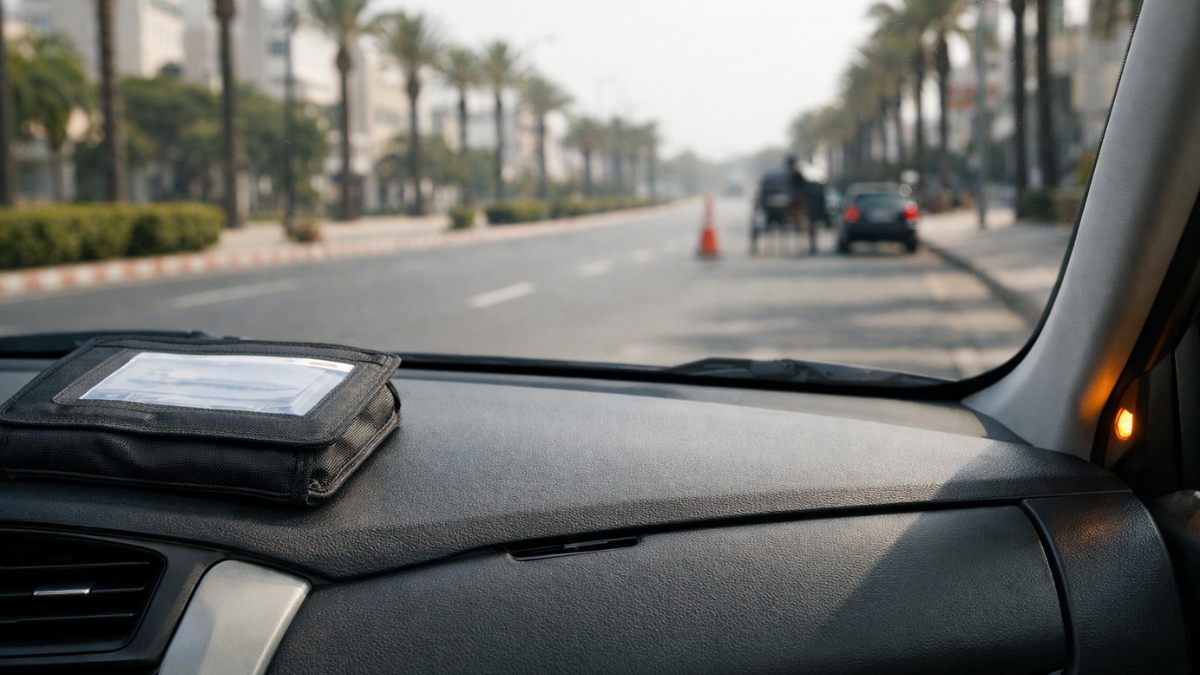
Getting stopped by police while driving in Agadir can feel intimidating, especially if you’re visiting Morocco for the first time. In reality, most stops are routine: document checks, speed-control points, or general safety enforcement. If you’re calm, prepared, and respectful, the interaction is usually quick and straightforward.
This guide explains exactly what to do, what documents to have ready, what to say (even if you don’t speak Arabic), and how to avoid common mistakes that cause delays.
Table of contents
- Why you might be stopped in Agadir
- The papers to show (what to keep accessible)
- The 60-second calm routine at the roadside
- What to say (simple phrases that work)
- Fines, receipts, and “on the spot” confusion
- Special cases: rental cars, company cars, and drivers
- What not to do
- FAQ
1) Why you might be stopped in Agadir
In and around Agadir, stops commonly happen for:
- Speed enforcement on major boulevards and ring-road style routes
- Document checks (especially at visible control points)
- Seatbelt / phone checks (quick compliance checks)
- Night driving checks near busy nightlife zones or main entries/exits
Most of the time, the officer is simply confirming that the driver and vehicle are properly documented.
2) The papers to show (what to keep accessible)
The goal is to hand over what’s needed without digging through luggage or searching for screenshots while the officer waits.
Keep these within easy reach (glove box + a small document pouch):
- Driver’s license
- Your valid license is the first thing they’ll ask for.
- If you carry an International Driving Permit, keep it with your license (not required for everyone, but useful if your license isn’t in a familiar format/language).
- Passport or ID
- A passport is the most universal ID for visitors.
- Vehicle documents
- In a rental, the car usually has official vehicle paperwork in the glove box (often a registration copy/vehicle card).
- Don’t panic if the documents look “official” and unfamiliar, just hand them over neatly when requested.
- Rental contract (or authorization to drive)
- This is important if the car is rented or belongs to a company.
- Make sure the driver name matches the contract or is listed as an additional driver.
- Insurance proof
- Often included in the rental paperwork.
- If you’re unsure, ask your rental provider where it’s stored (many keep it in the glove box with the vehicle file).
For general road-safety guidance and official public information, Morocco’s road-safety agency is a reliable reference: National Road Safety Agency (NARSA).
3) The 60-second calm routine at the roadside
When you see signals to stop, do this:
- Signal and pull over safely
Choose a safe shoulder or a wide curbside area. Avoid sudden braking. - Stay in the car unless asked
Keep your seatbelt on until you’re fully stopped. Hands visible on the wheel. - Turn down music and open the window
Small details reduce tension and speed up the check. - Be ready with documents, but don’t wave them around
Wait for the officer’s request, then hand items one by one. - Stay polite, short, and calm
Long explanations can confuse things. Answer what you’re asked.
Golden rule: your energy sets the tone. Calm driver = calm stop.
4) What to say (simple phrases that work)
You don’t need perfect language. A respectful tone plus a few simple phrases goes a long way.
If you speak a little French, these are helpful:
- “Bonjour, voici mes papiers.” (Hello, here are my documents.)
- “Je suis touriste.” (I’m a tourist.)
- “Je ne parle pas bien français.” (I don’t speak French well.)
- “Pouvez-vous répéter, s’il vous plaît ?” (Could you repeat, please?)
If you speak English only, that’s okay:
- “Hello. I can show my documents.”
- “I’m a visitor. Please speak slowly.”
If you’re using your phone to translate, do it politely and briefly, don’t start recording or filming.
5) Fines, receipts, and “on the spot” confusion
Sometimes drivers get stressed because they don’t understand what happens next. Here’s the practical approach:
- If the officer mentions a violation, stay calm and ask for clarity.
- If a fine is issued, you can politely ask for a receipt or written record of what’s being cited.
- Avoid arguing at the roadside. If you believe something is incorrect, handle it through proper channels later.
For official digital public services connected to national police administration, you can also reference e-Police Morocco (useful for understanding available services and official portals).
6) Special cases: rental cars, company cars, and drivers
If you’re in a rental car
- Make sure the driver name matches the contract (or you’re listed as an additional driver).
- Keep the vehicle file in the glove box, tidy and easy to access.
If someone else booked the car
- If the rental is under another person’s name, this can slow things down.
- Best practice: the person driving should be properly listed.
If you have a private driver
- Police checks become simpler for you because the driver handles communication and documents.
- A driver is often the best option if you’re uncomfortable with stops, driving at night, or navigating busy city routes.
7) What not to do
These are the mistakes that turn a quick stop into a long one:
- Don’t argue or raise your voice
- Don’t reach suddenly into bags or under seats (move slowly, explain what you’re doing)
- Don’t offer “solutions” or hint at anything improper
- Don’t film the officer unless you clearly understand local expectations and the situation is safe (it can escalate tension fast)
- Don’t hand over your phone unless you choose to show something specific (like a translation)
Keep it simple: polite, prepared, respectful.
FAQ
1) Will police in Agadir speak English?
Sometimes, but not always. French is more common. If you’re polite and slow down the conversation, most checks stay simple.
2) What documents do I need to show first?
Usually your driver’s license and ID (passport). Then vehicle papers and rental contract if requested.
3) If I’m driving a rental, where are the car documents?
Often in the glove box in a document wallet. Ask your rental provider at pickup so you know exactly what’s inside.
4) Can I use a phone photo of my documents?
It may help as backup, but physical documents are safer and faster for checks.
5) What if I don’t understand what I’m being told?
Stay calm, ask the officer to repeat slowly, and use short translation on your phone if needed.
6) When is it better to choose a private driver in Agadir?
If you’re arriving late, you dislike city driving, you’re traveling with family, or you want zero stress with stops and navigation.