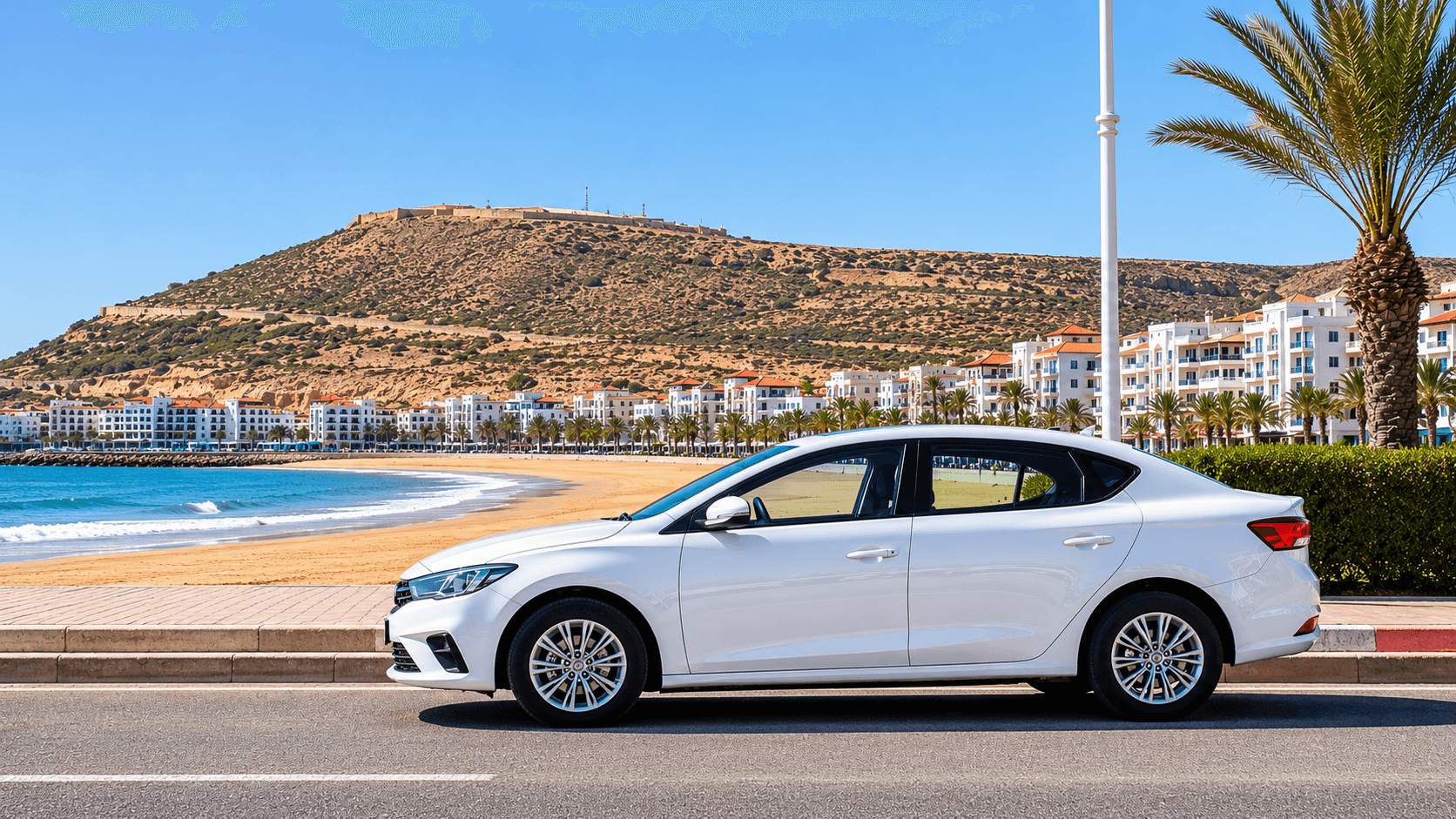









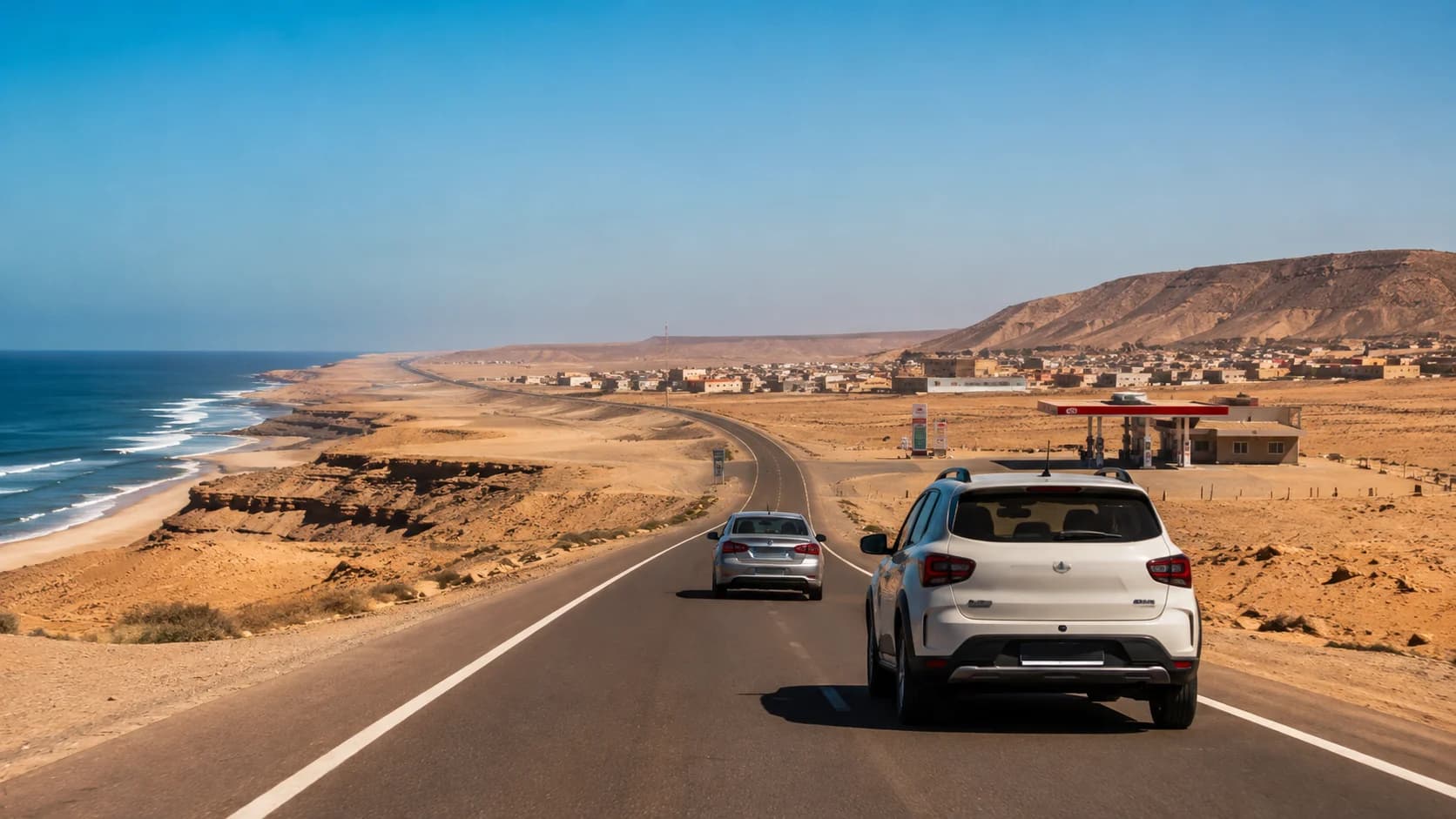
Driving from Agadir to Laayoune by car is one of Morocco’s most memorable long-distance journeys. The route follows the N1 south through Tiznit, Guelmim, Tan-Tan and Tarfaya before reaching Laayoune, combining Atlantic coastal scenery, open desert landscapes and several important southern towns.
Depending on the exact starting point, destination and navigation route, the road distance is approximately 620 to 640 kilometres. Online route calculations estimate around eight hours of continuous driving, but travellers should plan closer to nine to eleven hours once fuel stops, meals, traffic, roadworks and police checkpoints are included.
Although the journey can technically be completed in one long day, dividing it into two stages is usually more comfortable. Good preparation is particularly important because services become less frequent south of Tan-Tan and drivers may encounter strong winds, drifting sand and long sections with limited shade.
The Agadir to Laayoune route covers approximately 620 to 640 kilometres, mainly on the paved N1 national road. A realistic journey takes nine to eleven hours, including normal stops.
A standard sedan is normally suitable because the main route is paved. An SUV may be more comfortable for passengers carrying substantial luggage or planning side trips, while a 4x4 is generally unnecessary unless the itinerary includes unpaved desert tracks.
For a safer and less tiring trip, consider stopping overnight in Guelmim, Tan-Tan or Tarfaya rather than completing the entire journey in one day.
Agadir to Laayoune Route Overview
The most direct route from Agadir to Laayoune follows the N1, Morocco’s principal north-south Atlantic road.
The usual sequence is:
Agadir → Tiznit → Guelmim → Tan-Tan → Tarfaya → Laayoune
After leaving Agadir, drivers travel south through Ait Melloul and continue toward Tiznit. The landscape gradually changes from the populated Souss region to the drier surroundings of Guelmim.
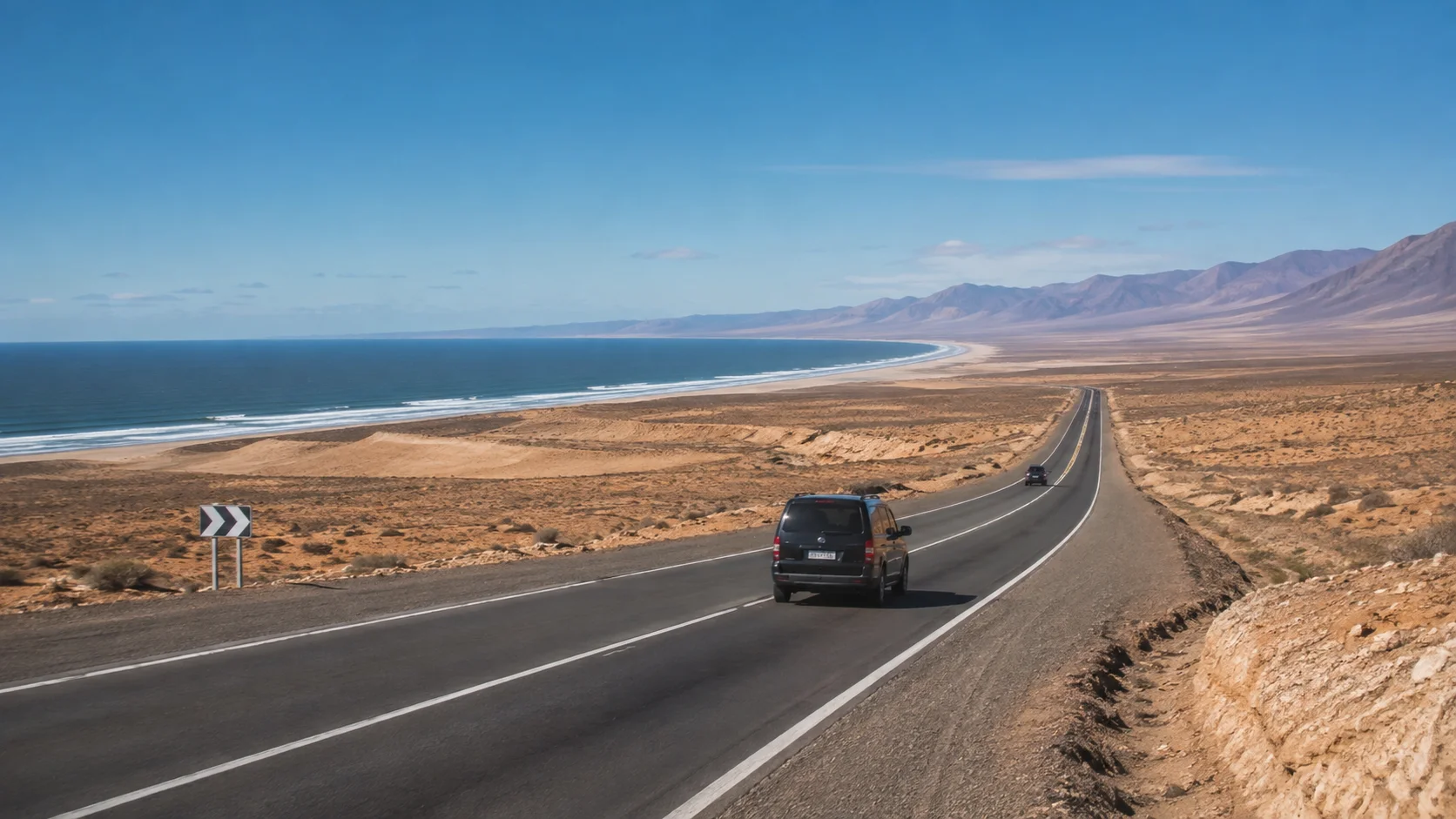
South of Guelmim, the road continues through open plains toward Tan-Tan. From Tan-Tan, the journey becomes increasingly remote, with longer distances between major towns and broad Atlantic Sahara landscapes.
Tarfaya is the final major coastal stop before Laayoune. From there, the N1 continues through exposed desert terrain before approaching the Laayoune urban area.
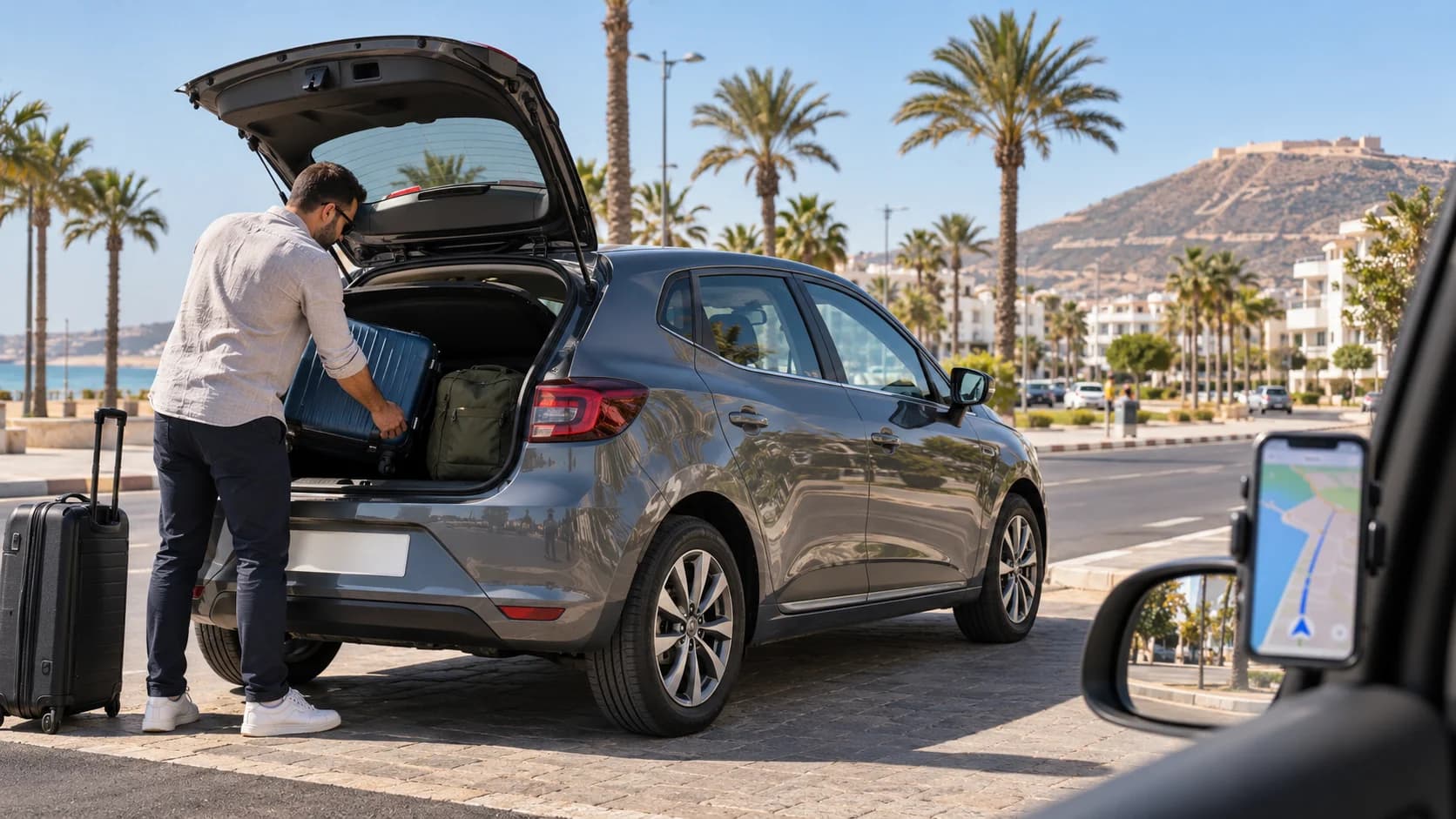
The route is relatively straightforward from a navigation perspective because most of the journey remains on the N1. Nevertheless, travellers should download an offline map before departure and avoid relying exclusively on mobile reception.
Agadir to Laayoune Distance and Realistic Driving Time
The precise Agadir to Laayoune distance depends on where the trip begins in Agadir and where it ends in Laayoune. Most route calculations place it between approximately 620 and 640 kilometres.
A navigation application may display a driving time of around eight hours. That should be treated as continuous wheel time rather than a complete travel-day estimate.
A more realistic schedule should allow:
-
Nine to eleven hours for a normal one-day journey
-
Additional time during roadworks or heavy traffic
-
At least two fuel or rest stops
-
Time for document checks at police checkpoints
-
Extra daylight margin during windy or dusty conditions
Large vehicles, local traffic and speed reductions near towns can lower the average speed considerably. Drivers should also slow down when visibility is reduced by dust, sand or coastal fog.
Trying to maintain the navigation application’s fastest predicted time is neither necessary nor advisable. The objective should be to arrive safely rather than to complete the route as quickly as possible.
Can the Journey Be Completed in One Day?
Yes, the trip can be completed in one day when:
-
The driver is comfortable with long-distance driving
-
The vehicle is collected early
-
Departure takes place around sunrise
-
Weather and road conditions are favourable
-
The driver takes regular breaks
-
Most of the route is completed in daylight
However, one person driving for ten hours or more may become tired. An overnight stop is the better choice for families, first-time visitors, older travellers and anyone who wants to explore the towns along the route.
Best Way to Divide the Journey
There are three practical ways to organise the drive.
Option One: Direct Journey in One Day
A direct journey works best with an early departure from Agadir, ideally no later than 7:00 a.m.
A possible schedule is:
-
Depart Agadir early in the morning
-
Stop briefly in Tiznit or Guelmim
-
Take a longer meal and fuel break in Tan-Tan
-
Continue through Tarfaya
-
Reach Laayoune before evening
This schedule leaves limited time for sightseeing. It should be viewed as a transport day rather than a leisurely road trip.
Option Two: Overnight in Tan-Tan
Tan-Tan provides the most balanced division of the journey. It is far enough from Agadir to complete a meaningful first stage but leaves a manageable second day through Tarfaya to Laayoune.
This option is suitable for travellers who want:
-
Two moderate driving days
-
A larger town for accommodation and supplies
-
Time to stop along the Atlantic section
-
Less pressure to drive late in the day
Option Three: Overnight in Tarfaya
Tarfaya is considerably farther south and creates a longer first day but a short second stage to Laayoune.
This arrangement works well for travellers who want to explore Tarfaya, spend time near the coast or arrive in Laayoune early the following day.
Because accommodation choices may be more limited than in larger cities, it is sensible to reserve a room before arriving.
Main Towns and Overnight Stops
Tiznit
Tiznit is one of the first useful stops after leaving Agadir. It is known for its historic walls and silver jewellery traditions, but on this journey it also provides convenient fuel stations, cafés, shops and basic vehicle services.
Travellers making the trip in one day may only stop briefly. Those following a slower itinerary can spend several hours in the town before continuing to Guelmim.
Guelmim
Guelmim is a practical first-night option for travellers departing Agadir later in the day. It has a wider range of accommodation, restaurants, fuel stations and shops than the smaller settlements farther south.
However, stopping in Guelmim leaves a substantial distance for the second day. It is best for travellers who prefer shorter first-day driving or want to explore the area.
Tan-Tan
Tan-Tan is the most logical midpoint stop for many itineraries. Drivers can refuel, buy water and food, inspect the vehicle and rest before continuing toward Tarfaya.
Tan-Tan Plage, also known as El Ouatia, is located closer to the coast and offers an alternative place to stay. Drivers should account for the additional distance involved in leaving and rejoining the main route.
Tarfaya
Tarfaya is a smaller coastal town and the last major stop before Laayoune. It is a useful location for fuel, refreshments and a final rest.
The road south of Tarfaya becomes visually open and exposed. Leaving the town with adequate fuel is strongly recommended even when the vehicle still has a reasonable amount remaining.
Laayoune
Laayoune is the main urban centre at the end of the route. Fuel stations, hotels, restaurants and other services are widely available within and around the city.
Drivers arriving near sunset should pay close attention to local traffic, roundabouts, motorcycles and pedestrians as the road transitions from open highway to urban driving.
Fuel, Food and Roadside Services
Fuel is available in the main towns, but stations and roadside services become less frequent as the journey progresses south.
A sensible refuelling strategy is:
-
Begin with a full tank in Agadir.
-
Reassess the fuel level in Tiznit or Guelmim.
-
Fill the tank in Tan-Tan.
-
Refuel again in Tarfaya when necessary.
-
Avoid waiting for the low-fuel warning light.
Petrol and diesel are generally available on Morocco’s principal routes, but remote-road planning should never assume that every individual station will be open, operational or able to accept card payments. Carrying some Moroccan dirhams is therefore useful.
Drivers should also carry:
-
Drinking water
-
Light food or snacks
-
A charged mobile phone
-
A charging cable or power bank
-
Offline navigation
-
Basic sun protection
-
Any essential medication
-
The rental company’s emergency number
There are cafés and restaurants in the main towns, but fewer dependable choices on the remote sections. It is better to buy supplies before leaving Guelmim or Tan-Tan.
Road Conditions and Police Checkpoints
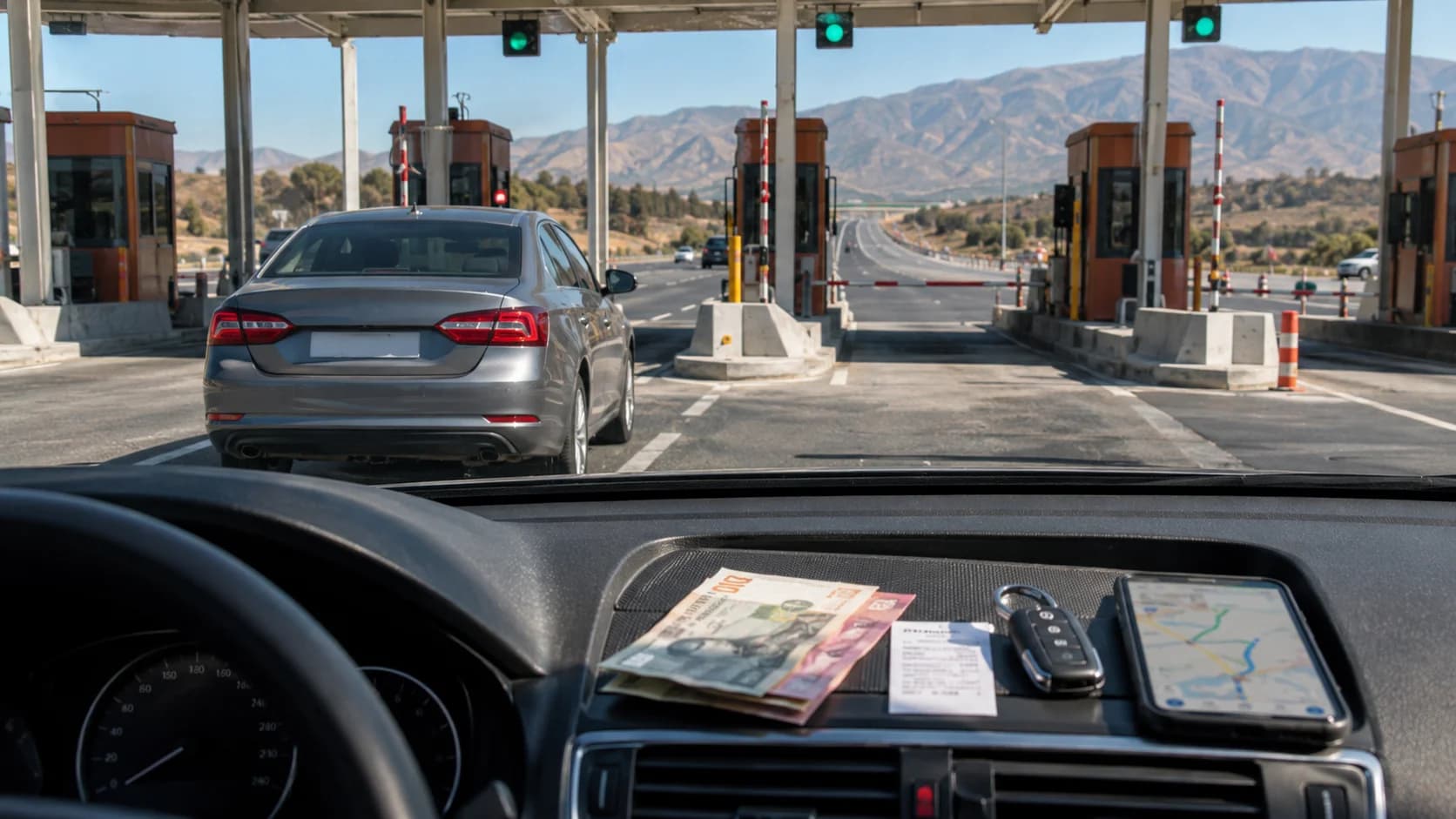
Is the Agadir to Laayoune Road Paved?
The principal route between Agadir and Laayoune follows the paved N1. Under normal conditions, it can be driven in an ordinary passenger car.
However, “paved” does not mean every section will have the same width or surface quality. Drivers may encounter:
-
Road improvement projects
-
Temporary lane diversions
-
Uneven road edges
-
Slow trucks
-
Narrow sections
-
Sand or debris near the carriageway
-
Animals close to the road
-
Reduced visibility after dark
Road conditions can change, so drivers should ask the rental company about recent route information and pay attention to temporary signs.
Police and Security Checkpoints
Police or gendarmerie checkpoints are normal on long-distance Moroccan roads, particularly when entering or leaving towns and travelling into the southern regions.
Drivers should:
-
Reduce speed well before the checkpoint
-
Stop when instructed
-
Keep both hands visible
-
Remain polite and patient
-
Follow the officer’s directions
-
Have the required documents accessible
Checkpoint delays are usually brief when documents are in order. Travellers should never photograph security installations or checkpoint personnel.
Official travel guidance also advises drivers to carry a valid driving licence, vehicle registration and insurance documentation.
Avoid Driving at Night
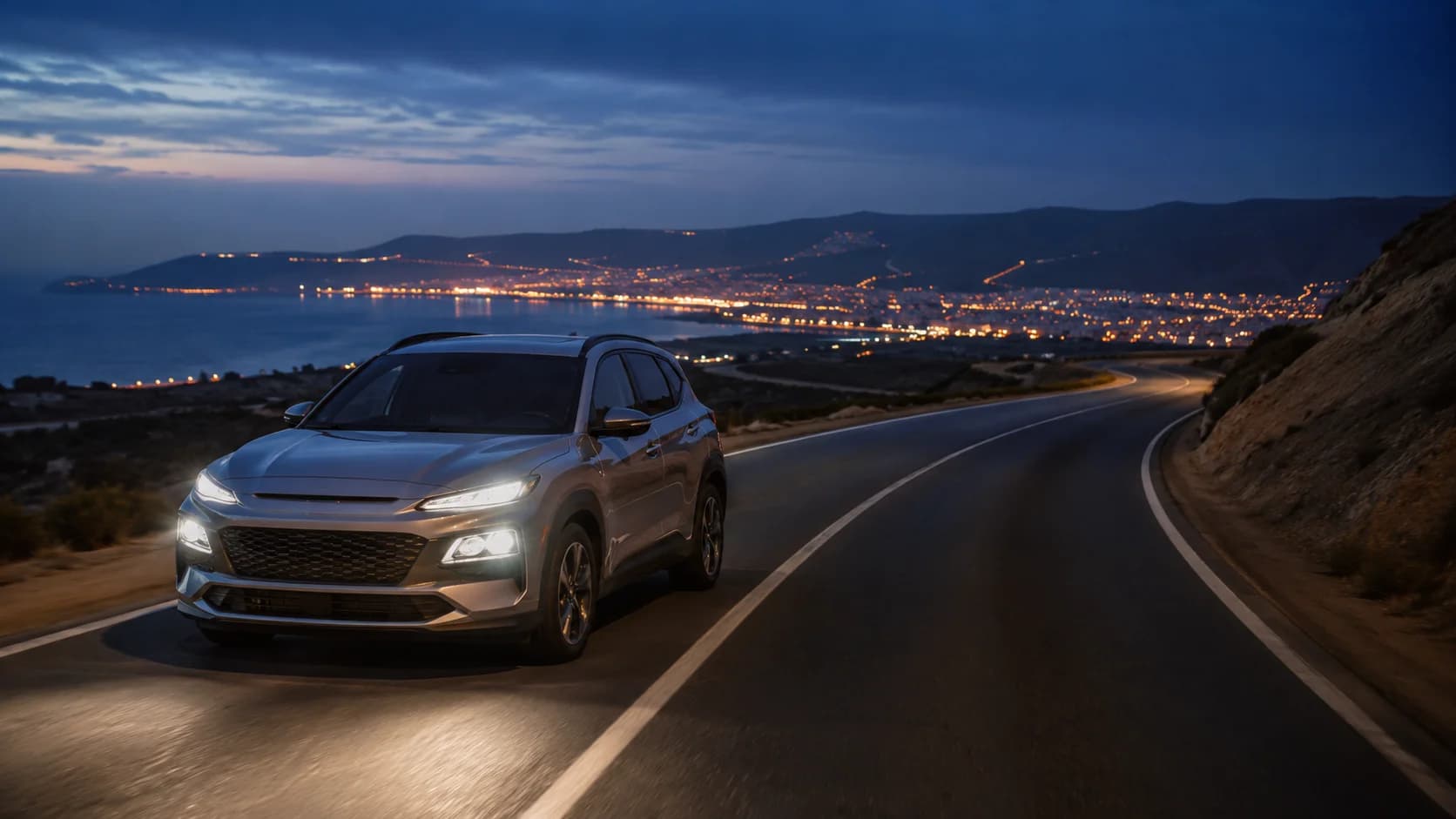
Night driving is not recommended unless necessary. Unlit vehicles, pedestrians, animals and roadside obstacles can be more difficult to see after dark.
Remote sections also provide fewer immediate options if the driver experiences a puncture, mechanical issue or severe tiredness.
Plan the journey so that the final driving stage ends before sunset whenever possible.
Standard Car vs SUV vs 4x4
A common misconception is that every journey toward southern Morocco requires an off-road vehicle. For the main Agadir–Laayoune road, that is generally not the case.
Sedan
A sedan is suitable when:
-
Travelling entirely on the N1
-
Carrying two to four passengers
-
Using normal luggage
-
Prioritising fuel efficiency
-
Staying in towns or established accommodation
A comfortable modern sedan can complete the paved route without difficulty under normal conditions. Travellers can compare suitable options through sedan rental Agadir.
SUV
An SUV may be preferable when:
-
Carrying several large suitcases
-
Travelling with children
-
Wanting a higher seating position
-
Planning coastal or rural side trips
-
Prioritising additional cabin space
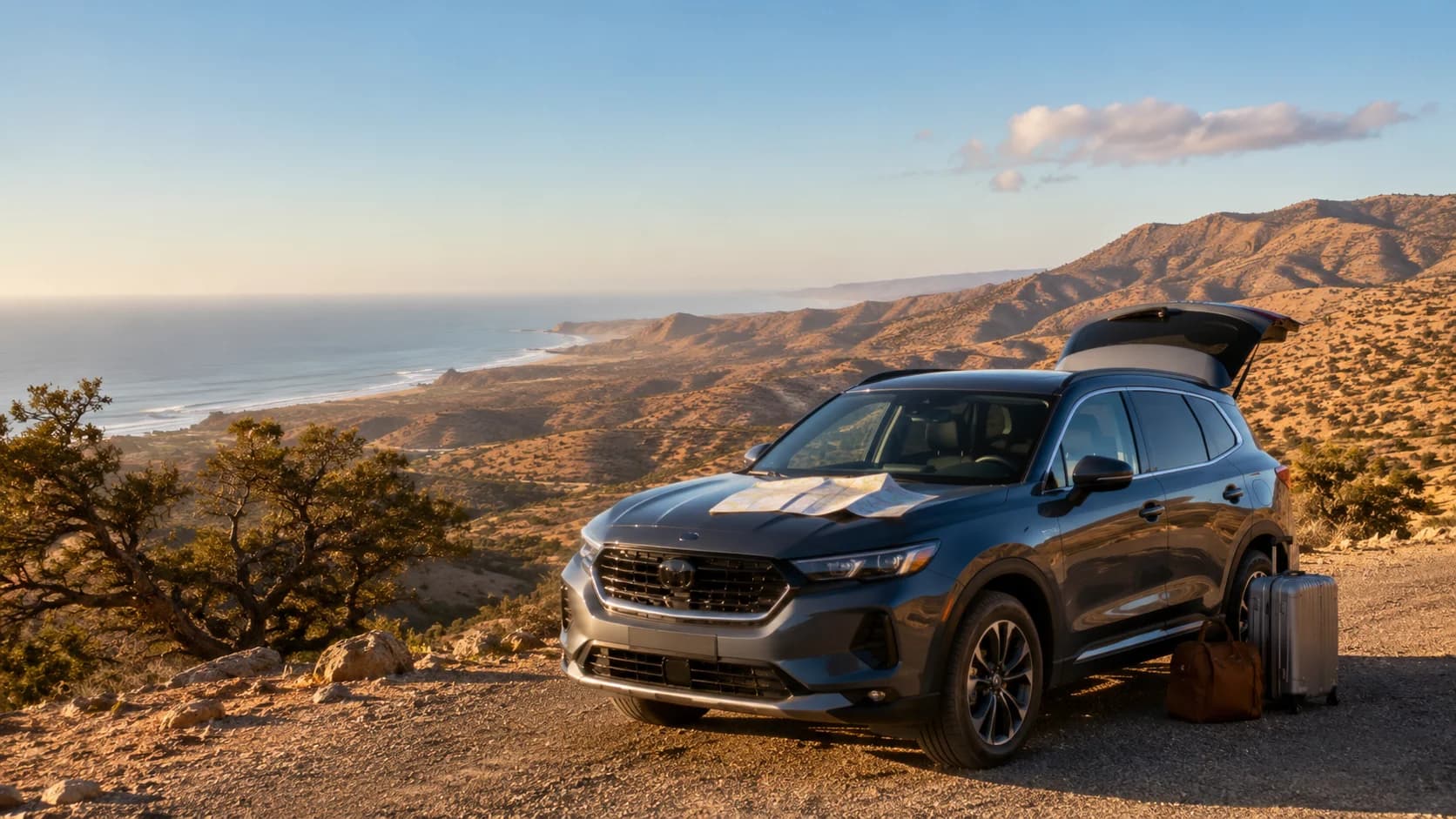
An SUV can provide more comfort and luggage capacity, but it does not remove the need to drive cautiously in wind or reduced visibility. Available models can be reviewed through SUV rental Agadir.
4x4
A 4x4 is generally unnecessary for the direct paved journey to Laayoune.
It becomes relevant when the itinerary includes:
-
Approved unpaved tracks
-
Remote desert accommodation
-
Organised off-road excursions
-
Difficult rural access roads
-
Equipment or luggage requiring additional capacity
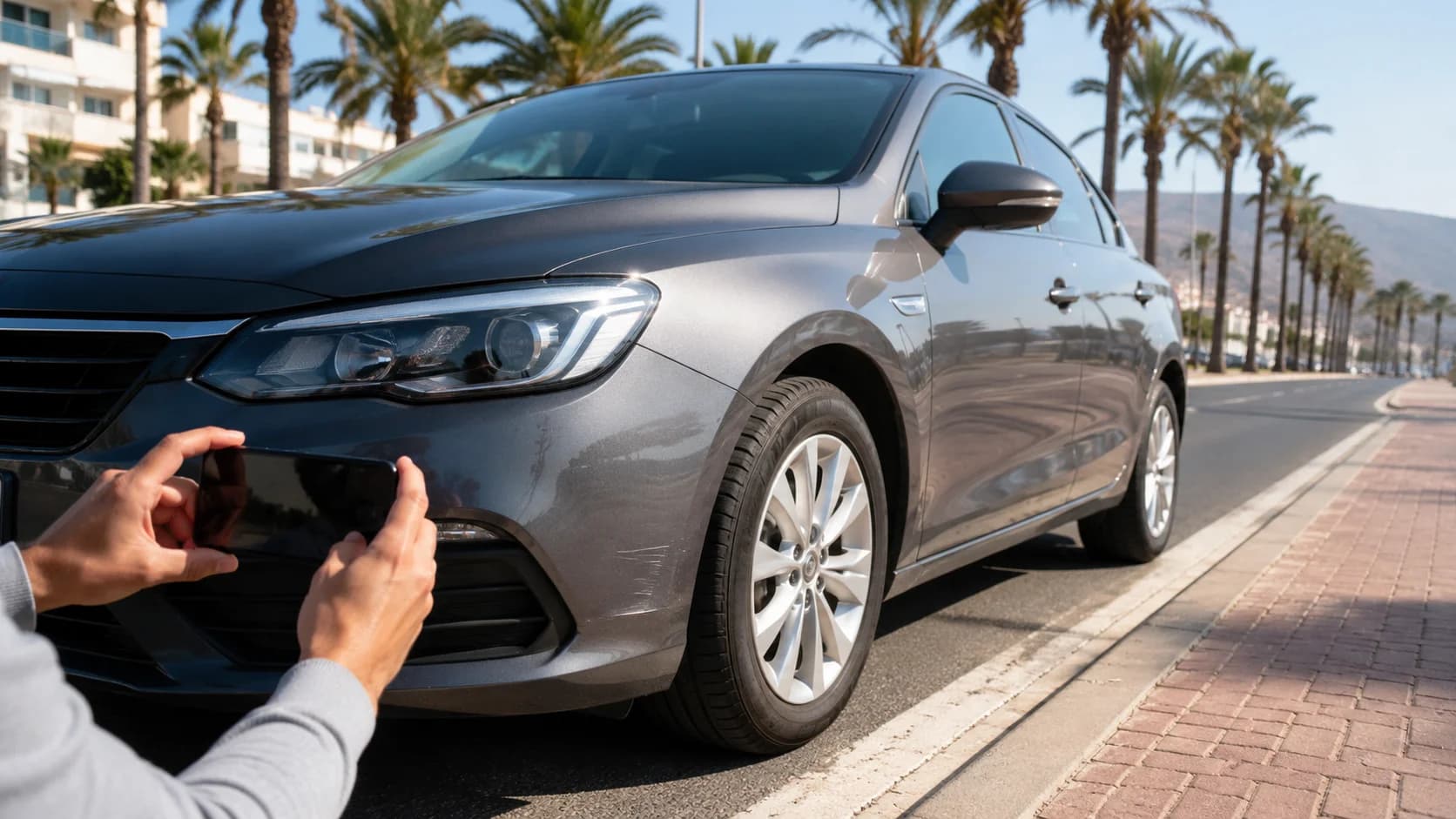
Before leaving paved roads, travellers must confirm that the rental agreement permits off-road use. Standard insurance may exclude damage occurring on unauthorised tracks.
For specialised itineraries, compare the conditions attached to 4x4 rental Agadir.
Weather, Wind and Visibility
The Atlantic Sahara has a dry coastal climate influenced by ocean winds. Laayoune receives abundant sunshine and limited rainfall, while Atlantic air helps moderate temperatures.
Wind deserves particular attention. Historical climate data indicates that Laayoune’s windier period generally occurs from late May to early September, with July among the windiest months.
Strong crosswinds may affect:
-
High-sided vehicles
-
Light hatchbacks
-
Overtaking manoeuvres
-
Vehicle stability in exposed areas
-
Visibility when loose sand crosses the road
Drivers should reduce speed, hold the steering wheel steadily and allow more space when passing trucks.
Coastal Fog
Morning fog or ocean haze may occur near the coast. Visibility can change quickly, especially around exposed Atlantic sections.
Use dipped headlights when visibility is reduced and avoid sudden overtaking.
Heat and Sun Exposure
Even when coastal temperatures are moderate, the sunlight can be intense. Never leave children, pets, electronics or temperature-sensitive items inside a parked vehicle.
Check tyre condition and coolant levels before departure, particularly during warmer months.
Rain and Local Flooding
Rainfall is limited, but occasional heavy rain can affect drainage and low-lying areas. Never attempt to cross moving water or a flooded section of road.
If conditions appear unsafe, wait in a town or service area until visibility and road access improve.
Documents and Rental Permissions
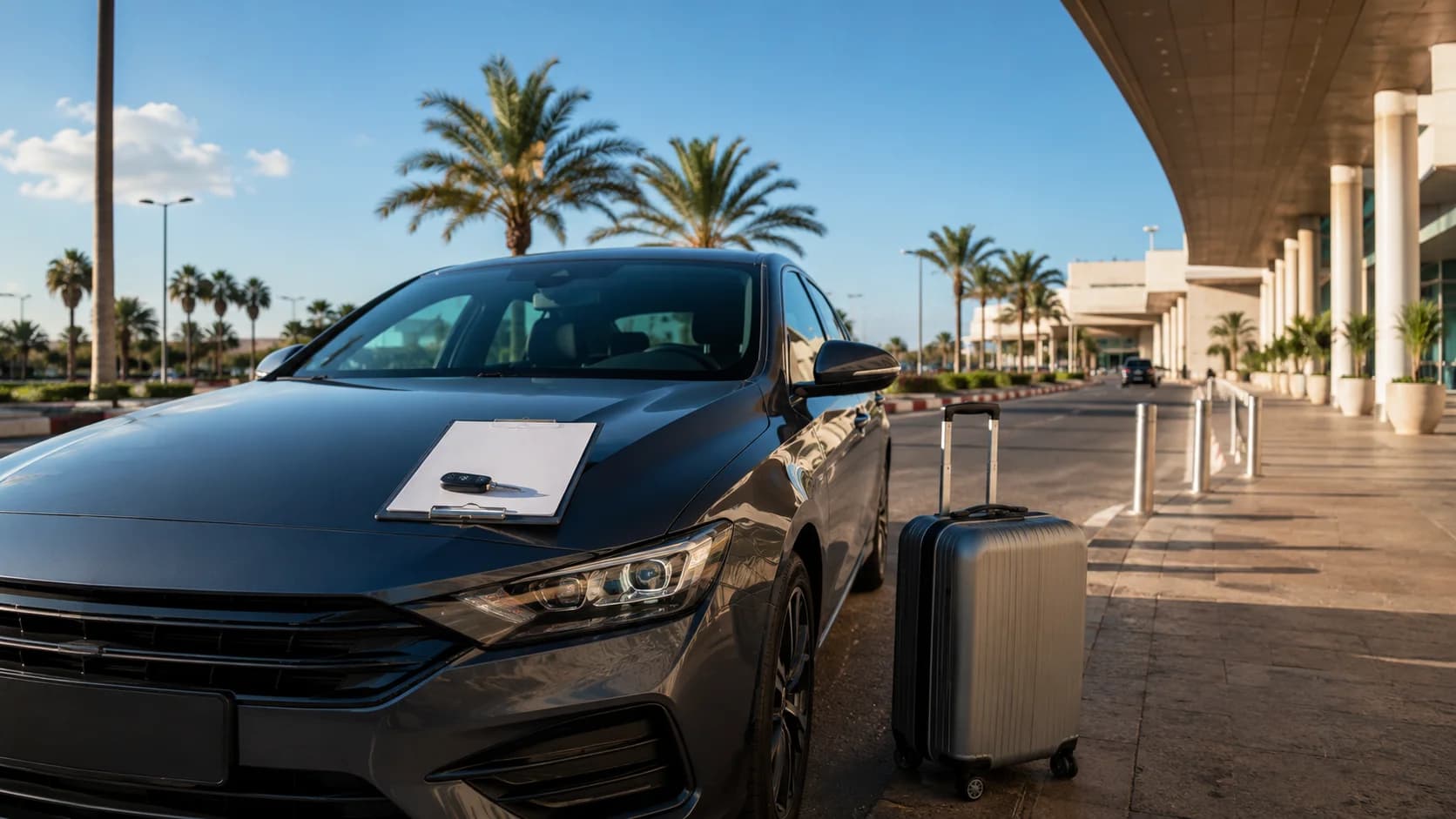
Before beginning the journey, confirm that the rental company permits travel to Laayoune.
Policies can vary according to:
-
Vehicle category
-
Mileage allowance
-
Insurance provider
-
Geographic restrictions
-
Roadside-assistance coverage
-
Rental duration
-
One-way return arrangements
Do not assume that permission to drive within Morocco automatically includes every remote road or off-road track.
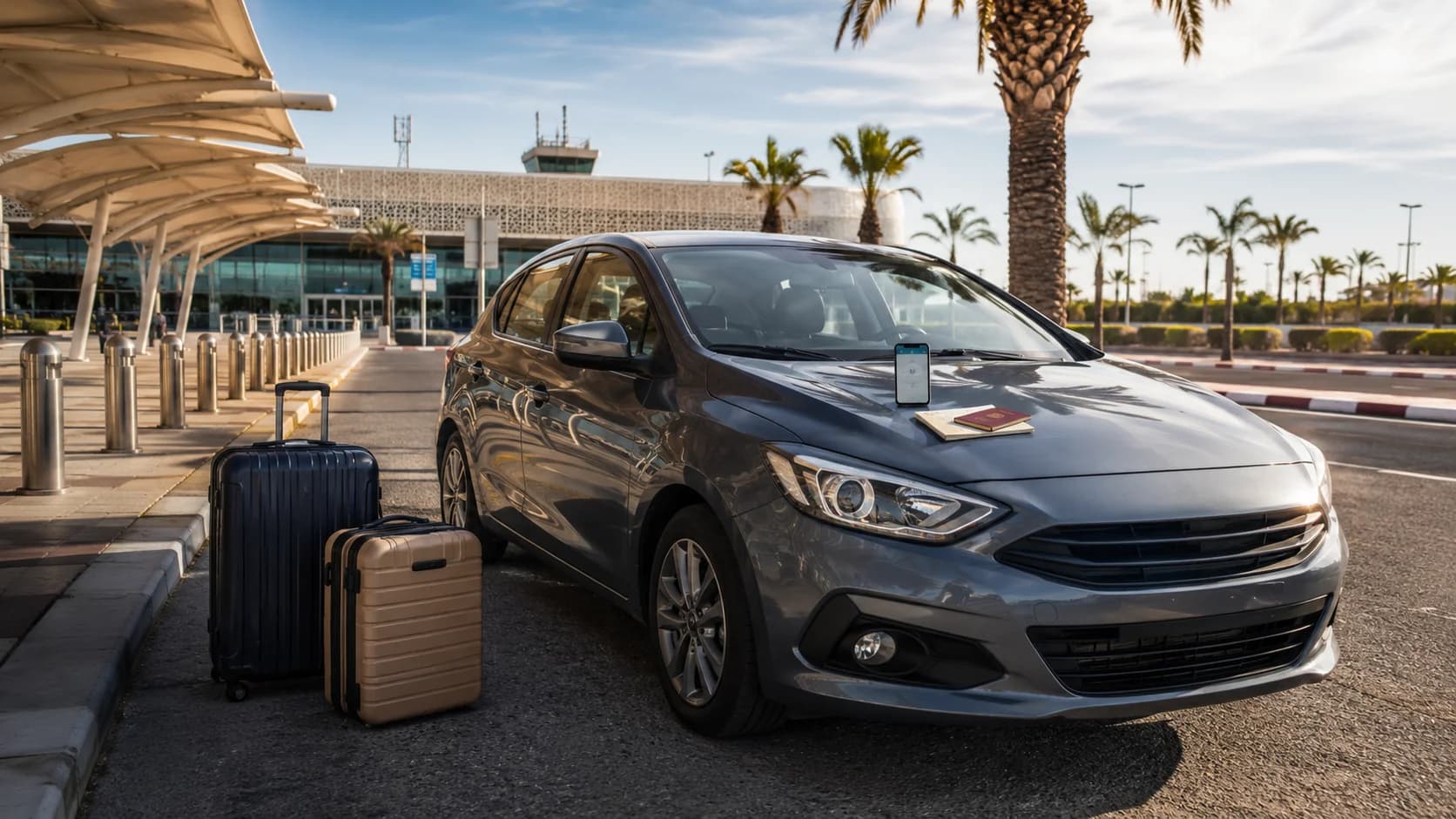
Keep the following documents in the vehicle:
-
Valid driving licence
-
Passport or accepted identification
-
Rental agreement
-
Vehicle registration documents
-
Insurance documentation
-
Rental company contact details
Drivers in Morocco are expected to carry their licence, registration and insurance documents.
International visitors should also check whether their domestic licence is accepted or whether an International Driving Permit is recommended for their nationality and rental provider.
Mileage Conditions
A round trip between Agadir and Laayoune can exceed 1,200 kilometres before including local driving or detours.
Ask the rental company:
-
Whether mileage is unlimited
-
Whether a daily kilometre limit applies
-
How excess kilometres are calculated
-
Whether roadside assistance reaches the entire route
-
Whether a second authorised driver can be added
These details should be confirmed before collection, not after beginning the journey.
Agadir to Laayoune Route-Planning Checklist
Before leaving Agadir, complete the following checks.
Vehicle
-
Tyres appear properly inflated
-
Spare wheel or puncture kit is present
-
Fuel tank is full
-
Headlights and indicators work
-
Air conditioning operates correctly
-
Warning triangle and reflective vest are available
-
Windscreen-washer fluid is sufficient
Documents
-
Driving licence
-
Passport or identification
-
Rental agreement
-
Registration papers
-
Insurance documentation
-
Written confirmation of route permission
Navigation and Communication
-
Offline map downloaded
-
Phone fully charged
-
Power bank packed
-
Emergency numbers saved
-
Accommodation location saved
-
Family or friends informed of the itinerary
Supplies
-
Drinking water
-
Snacks
-
Cash in Moroccan dirhams
-
Sun protection
-
Basic first-aid items
-
Essential medication
Timing
-
Depart early
-
Avoid an unnecessary rush
-
Schedule breaks every two hours
-
Refuel before remote stages
-
Aim to arrive before sunset
-
Stop driving when tired
Frequently Asked Questions
How far is Laayoune from Agadir by car?
Laayoune is approximately 620 to 640 kilometres from Agadir by road, depending on the exact starting point, destination and route calculation.
How long does it take to drive from Agadir to Laayoune?
Continuous navigation estimates may show about eight hours, but a realistic journey usually takes nine to eleven hours after including fuel, meals, traffic, checkpoints and rest breaks.
Can the journey be completed in one day?
Yes. An experienced driver can complete the journey in one day by departing early and limiting stops. However, an overnight stay in Tan-Tan or Tarfaya is usually more comfortable.
Where should I stop overnight between Agadir and Laayoune?
Tan-Tan provides the most balanced overnight stop. Guelmim is suitable for a shorter first day, while Tarfaya works well for travellers who prefer a longer first stage and a short final drive.
Is the road to Laayoune paved?
Yes. The direct route mainly follows the paved N1. Temporary roadworks, diversions, narrow sections and sand near the road may still require additional care.
Do I need a 4x4 to drive to Laayoune?
No. A sedan is generally suitable for the paved N1. An SUV may provide more passenger and luggage space, while a 4x4 is mainly useful for authorised unpaved routes or specialised desert itineraries.
Are fuel stations available along the route?
Fuel is available in the main towns, including Tiznit, Guelmim, Tan-Tan, Tarfaya and Laayoune. Drivers should refuel early rather than waiting until the tank is nearly empty.
Are there police checkpoints on the road to Laayoune?
Yes. Drivers may encounter police or gendarmerie checkpoints, especially near towns and on southern sections. Slow down, follow instructions and keep the driving licence, rental agreement and vehicle documents accessible.
Can I take an Agadir rental car to Laayoune?
That depends on the rental company, vehicle, mileage policy and insurance conditions. Obtain confirmation before departure and ask whether roadside assistance covers the complete route.
What is the best time of year for the drive?
The route can be driven throughout the year under suitable conditions. Spring, autumn and winter often provide comfortable temperatures, while summer travellers should prepare for stronger winds, intense sunlight and seasonal traffic.
Plan Your Agadir to Laayoune Road Trip
Driving from Agadir to Laayoune is achievable in a normal rental car when the journey remains on the paved N1. The most important considerations are realistic timing, early fuel stops, regular breaks, appropriate documents and permission from the rental company.
Avoid choosing a vehicle based on the assumption that the entire route is off-road. A sedan may be completely suitable for two or three travellers, while an SUV offers additional comfort for families and luggage. A 4x4 should be selected when the wider itinerary genuinely requires it.
Plan the southbound journey with the right car. MarHire Car Agadir can help confirm route suitability, mileage terms and a sedan, SUV or 4x4 matched to your passengers, luggage and travel plan.